Showing posts with label Isaac Hatch. Show all posts

Monday, December 14, 2015

Cult Films and Star Wars

I remember that during Olivia's presentation, one of the main descriptors she had for a cult film was "bad." Cult films are regularly bad, she said. However, I do not believe that that is a true description of a cult film. Of course, there are many that are bad. She gave plenty of examples, including Sharknado and The Room. (If her presentation was specifically about "bad cult classics," please correct my false statements.)

But there are also good movies that are considered cult films with cult followings. The Big Lebowski, although some might argue was a bad film, seems to have more substance than the films that were listed during the presentation. That film was definitely a cult classic, and some people are still part of the passionate group of fans that love that movie. 


Doctor Who, Star Trek, Harry Potter, The Lord of the Rings, Game of Thrones, Back to the Future, Mad Max, Fight Club, Fargo, The Goonies, and Monty Python films are all cult films/series, many of which were mainstream hits as well. The list goes on, and it includes some great films that are some of the best of all time.

Of course, we cannot leave out Star Wars, the films with one of the biggest cult followings ever. Of course, it has now become a mainstream series that many people follow with somewhat less of a cult-like passion, but there are nevertheless the cult-followers that are hanging on to these movies, anxiously awaiting the next one. There are 3 days, 9 hours, 40 minutes, and 29 seconds left according to the Star Wars website.

Star Wars has been followed for years by a bunch of wackos doing crazy things.

Star Wars fan Caroline Ritter of Hunter Valley, Australia, sleeps while waiting first in line for a chance to see the last episode in the Star Wars Saga, "Star Wars: The Force Awakens" at the TCL Chinese Theater Imax in Los Angeles on Wednesday, Dec. 9, 2015. Ritter is planning to get married at the historic theater with a Star Wars themed wedding before the premiere of the film. (AP Photo/Damian Dovarganes)

I can't say that I'm not looking forward to The Force Awakens, but I think I will stay away from the cultish stuff.

Thursday, December 3, 2015

Bridging the Gap


Songs and music videos that involve fans or random audiences can be incredible. Of course, a lot of work must go into a music video that has audience involvement if the artist is looking for a specific outcome. The Japanese song that we listened to in class seemed to have a very organized and controlled video. It must have taken so much time and effort to control the outcome of that video, making it exactly what the artist wanted.


On the other hand, the artist could give more freedom to the crowd and let them do what they want to do. The video for Johnny Cash's "Ain't No Grave" that we watched in class falls into this category. Even though there was a framework to work with, the crowd could draw anything that they wanted in the video. There can be unwanted outcomes when it comes to this type of process, especially if the video-makers are not paying careful attention to what is being done by the audience. 

A music video that comes to mind is the one for Justin Bieber's and Jack Ü's song "Where Are Ü Now." The crowd was given free rein to draw whatever they wanted onto frames of Justin Bieber moving around. With many people out there who approach Justin Bieber with disdain, there was bound to be some unwanted outcomes in the video. If you watch it, the frames go by fairly quickly, but if you pause it, you might find yourself staring at crude remarks and pictures. Maybe those who were putting together the video did it without checking the individual drawings or released it in spite of them. Either way, I find it kind of great that there were no censors. It makes it feel real, and in reality, those who wrote the crude comments and drew the inappropriate pictures seem like the childish ones in the end.


But the best audience-participation  music videos are the ones that are a collaboration of the artists and their fans. It gets rid of the invisible wall, the barrier that keeps the artists as something off in the distance that can sometimes inspire idolatry. Bringing people in who like the music together with the artists can be summed up in saying, "Hey, we're all humans. We all get the feels when we listen to music. Let's do this stuff together." At least, on the audience's side, it feels like gaps are bridged.

"Playing for Change," "Sour," "First Day of My Life," and even "Ain't No Grave" brings people together and unites humankind in a video. Being a part of something can feel great, and I love watching these kinds of videos. Especially those of bands that are not at the top of the billboard. The bands feel loved by their fans, and the fans enjoy being a part of something even if it is not the biggest-budget video of all time.


Tuesday, December 1, 2015

Music Videos Are Not Badly-Made Films


Music videos can be a very cool film "genre," I guess you would call it. Music is a very powerful thing, which is usually used as a complementary item in films. I would venture to say that the music greatly affects your perception of a film. A film with a bad score seems sort of mediocre, but with a great film score, you tend to have films that you enjoy. Of course, when viewing a film, you go for the content, the story line. Without a good one, people label the movie as bad whether there was good music or not. But there are still those people that get the soundtrack of bad movies because they enjoy the music.

For music videos, that concept is flipped. The video, or film, is the thing that is complementary to the music. The song, the music, is what you go for. Watching a music video that is not that great will affect your perception of the collaboration of song and video, maybe even lowering your view of the song itself. If the song is bad, people may watch the video anyway because it was a great video. 

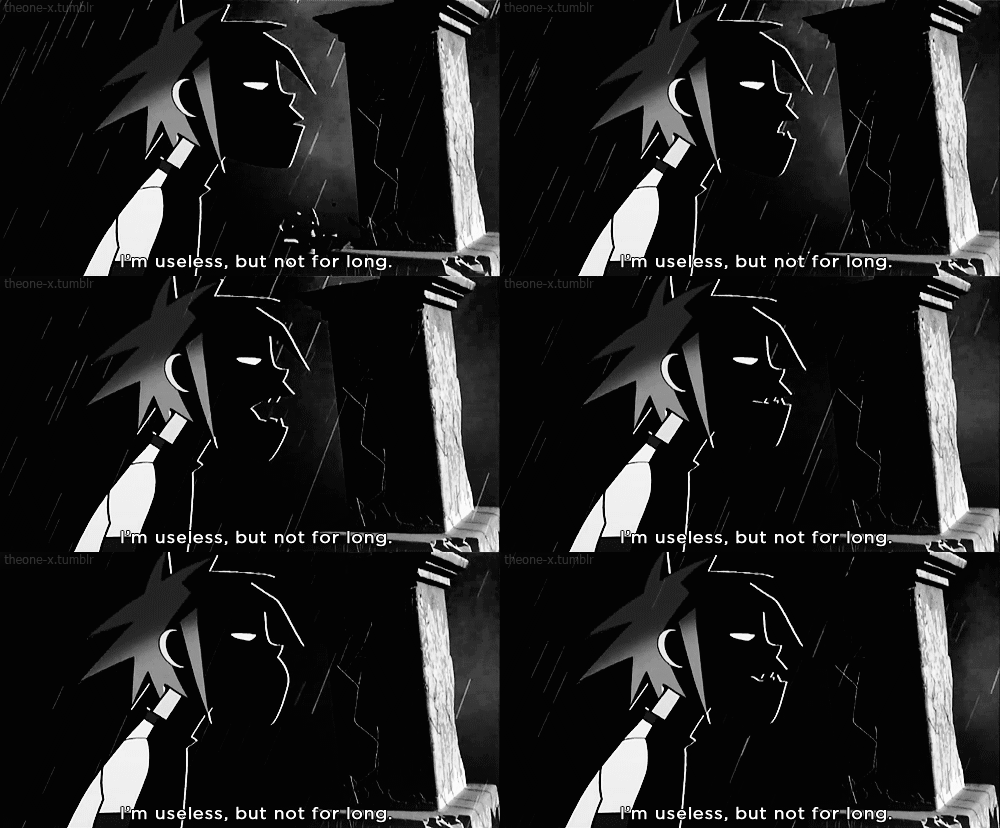
I love artists that do creative things with their music videos. That is one reason why I really like Gorillaz. Their music videos are a wide range of animated creative pieces, always starring the same fictional band characters. Some of them are 2D. In fact, I thought that we would be watching the actual music video of Clint Eastwood in class today, which is a 2D animation, like their top single Feel Good Inc (you've probably heard it). Others of their videos combine CG and 2D animation and even animation and live action, as in Stylo (Bruce Willis appears in it). 

The great thing about music videos being a big part of the internet is that there are so many of them, and there are some videos that stick with people for a long time. For me, one of those videos is the music video for Papaoutai by Stromae. It is probably one of my favorite music videos. I first saw it during an exam week two years ago and instead of studying watched in on repeat for a while. Great combination of music, dance, and story. You might have seen it before.


Tuesday, November 24, 2015

Passing Hearts


I really liked the Passing Hearts short film that we watched today. I enjoy films that keep your brain engaged in the experience of the film. Films that leave bread crumbs for you to follow.

I especially appreciate films that require the audience to be intellectually active. This was not necessarily one of those films, since the letter at the end revealed the story line in plain terms for anyone to understand. But it came close. And if you didn't exactly understand what was going on until the reveal, the aha moment is also something that is enjoyable.

I grew up in a family that watches a lot of murder mysteries and appreciates movies that need to be closely followed to be understood. Movies that I once considered to be boring (Maybe some Harrison Ford drama/thriller). Anyways, somehow I have also turned into one of those people that likes those kinds of films and stories. I guess that now I need more than explosions and silly puns to entertain me (What?! Not really. I will always love a good pun).

I liked the real feel of Passing Hearts as well. International films seem to do that. They give you something different, but it's not fakey, like say the last film we watched in class today (which might be too over-the-top fakey. How about Spectre? That was a serious, fakey movie.). It's good to see a glimpse of life from another country, that can actually be passed as real. Hearing real Swedish dialogue and reading subtitles adds to the experience as well.

The story was pretty cool in itself. There was some real connection there between the characters. Some powerful stuff.

Tuesday, November 17, 2015

Vocari Dei


The song, documentary audio, recorded messages, or whatever you want to call that thing that we listened to at the end of class, was pretty interesting. Vocari Dei, the name of the song, was made by the band Pain of Salvation. I thought that it was just a stand-alone thing made by someone who wanted to do a documentary-type thing, but apparently this band makes a lot of concept music. This particular song was part of the album BE, which "focuses on the existence of God and humankind." I will definitely check out some of their other songs and albums when I have some free time.

I liked the song a lot, even if I couldn't exactly hear/comprehend much of what was being said. The music sort of covered the voices up. You didn't really have to hear what they were saying though, to understand that some were confused, others disbelieving, and most of them vulnerable. You would have to be at least a little vulnerable and confused to take the steps to call the number provided, to "talk to God."

Some of the people were definitely discontent, maybe even angry with the world. One was asking why life was so cruel, another saying that she didn't believe in a God, but she knew what a God should be. 

It reminds me of a song by this band I like. In it, they sing: "As the waves crash high, and the shoreline disappears, I will scream to the sky: Hey, people live here."


Friday, November 6, 2015

Hedgehog in the Fog Revisited (+ C.S. Lewis)


Hedgehog in the Fog is a short film that is portrayed in a style that would be considered "animation for children." And how great it is h that that is the style Yuri Norstein chose to make Hedgehog in the Fog. A style that would be considered "for adults" would not have been a good style for this short. A live action hedgehog? Nope.


C.S. Lewis wrote "On Three Way for Writing for Children" and included "writing a children's story because a children's story is the best art-form for something you have to say." That holds true for films as well. Hedgehog in the Fog is not exclusive to children. Adults can watch it as well and enjoy it, perhaps taking something away with them when they leave. Our class is the prime example. We watched it and enjoyed it. We may be childish, but we're not children.

Personally, I took a couple things away with me after watching the short film. It stuck out to me that following one's curiosity into the risky unknown might not end in disaster after all.

Along with that, even though you might think that you know you are going to die (or less extreme: something will not end well for you), you could turn out to be completely wrong. 

What wonderful things to learn at any age. Even though the medium may be a children's story, C.S. Lewis says that the medium may be the perfect thing for what you are trying to convey to every audience.

Tuesday, November 3, 2015

Short Film Substance Vs. Style


I enjoyed watching the short films today. Seeing what one or a few people can create is very enjoyable and also somewhat inspiring. A goal of many DMA students is to eventually create a film or help create one.

I especially liked The Dog Who Was a Cat Inside. It used a unique style, and it told an interesting story. I tend to like short films that present an idea or question ways to deal with controversial or unpopular situations in society. If you have a presence in society that people expect to fulfill certain roles, but your inner-self wants to act contrary to those expectations, how do you deal with that? It is an interesting concept to think about. It could be about transgender or other things as well. I do like films that make you think, which is why I also liked Un Jour.

So, for that reason, I did not like the substance of the previous three films we watched. The Hell's Kitchen had people dying coincidentally. After You's deepest meaning to offer was the conflict over being the "kindest/nicest." Pfffirate did not provoke any profound thinking. A metal bird in a world of balloon objects? There is a conflict, but what implicit meaning could it provoke? I guess it could represent people's lack of tolerance towards something that is a foreign concept to them. That may be deep to some, but it is a popularly accepted idea from what I've seen.


Even though Pfffirate did not make me think much, I liked it because it was entertaining, the way many feature films today are brainlessly entertaining. I definitely liked the style in the film. Even though it is probably easier to produce than detailed Pixar or Dreamworks-esk animation, it looks good and still most-likely takes a long time to make.

Tuesday, October 27, 2015

Painting on Glass Animations


The concept of animating by painting on glass is definitely an interesting one. Paintings, when well done, can be very beautiful, and an animation made of beautiful paintings is something incredible. Painting on glass seems a bit risky as well. Your separate paintings are not saved in physical form. You cannot alter the original medium later. Each and every painting is changed in its original form to become something new, which seems difficult.


Both the films we watched in class that used this medium I liked. The Street was more simply-animated than Strings, yet I understood the story just as well, if not better. That shows that it is not detail that makes a story. I am a detail-oriented person, so that is something to learn from. Strings was very beautiful, yet I did not understand the point of the film. Did the woman know someone who had died on the Titanic? What happened to the fiddlers downstairs? I cannot grasp the deeper meaning.

The Street was not as colorful or clearly animated as Strings. I can understand why. It must take forever, as Professor Leeper said, to go into much detail while using this medium. However, doing just that would create a masterpiece. For example, I found this animated version of Hemingway's Old Man and the Sea that was made using painting on glass. It is truly a masterpiece.


Thursday, October 22, 2015

The Man Who Planted Trees


Montreal Botanical Garden

The Man Who Planted Trees was a very beautiful film to watch. I enjoy listening to stories being read, and I like Frederick Back's animation a lot, so a mix of both was very cool. Back's style is different than what people in the modern world think of when they hear the word "animation." Most might think of Cartoon Network, anime, or Disney, Dreamworks, and Illumination Entertainment movies. Back's animation is like dream-inspired sketches that flow together with a certain surreal feel, in contrast to the solid, perfection-oriented animations from the previously named categories.

When the first World War was mentioned in the film, I began to wonder whether the story was telling real-life events. A quick search reveals that it is a short story by Jean Giono, who wrote a letter saying that Elzéard Bouffier was not real. The point of the story was to show planting trees in a good light. It is a good motive for making a story, and Dr. Seuss' The Lorax also has similar themes.

I love nature and trees, so that made the film just that much better. The ability for one man to plant an entire forest is an amazing thing to think about. Time to become a hermit and start planting oak trees. 
painting of a man planting a tree seedling

But, in all seriousness, maintaining the nature of the earth is something that should not be ignored. It is a good thing to do, and I admire artists that believe the same and choose their art subjects to be nature.
Oak forest - Ivan Shishkin


Tuesday, October 13, 2015

Moritz and Back (Extra Credit)


William Moritz said this to Frederick Back: "One terrifying thought to me is that since the same Radio Canada which closed down the Animation Department owns your films, they could presumably withdraw them from circulation, not show them, they could be lost, decay in the vaults."

It's a depressing thought. Art that many years produced could be lost forever, no-one being able to see the beautiful results of tedious work. That brings up the question that was briefly discussed in class today, "Would you make you art/films if no one would end up seeing them?" For Back, many people had already seen his work, so he was content (none of his work was actually withdrawn completely).

I would like to think that all people's art is seen by someone other than themselves. It's a depressing thought that any art goes unseen. Of course, people will make art to practice and hone their skills, but nobody works for many hours/days/years on a project that they will not show anyone. What would be the point? The way to make sure that no one out there is becoming like Narcissus, people have to share their art with each other.


An interesting thing that Back said was "I had the opportunity to go with [Meheut] and make drawings beside him. 'Draw everything,' he told us, 'it will all disappear.' He was right."

I do not draw things that I see often enough, and it is something that I regret and would like to change. Saving the image of something in art that may one day disappear is a wonderful thing to think of. People of the future could see beautiful things of the past in art. Of course, you would first have to share you art.

Friday, October 9, 2015

What can children watch?

I don't disagree with the idea that what kids watch on television affects their behavior. I have examples from my own childhood. I remember watching TV shows with government agents carrying guns, such as 24. Afterwards, I would get riled up and excited, and I would use objects to create fake guns. 

Some may argue that the effects of watching certain TV content are not good. I'm not too sure about that. I may have gotten riled up, but I do not think I would have caused harm to anybody. And even if I did as a child, it would have been better to learn back then the consequences, when I couldn't have done much harm, than now when I am capable of doing much worse.

Constantly watching content with immoral themes is not a good thing. That is why kids programs are controlled so that appropriate content is showed.

However, when people start to pick out small details that they claim are promoting immoral themes, they are going too far. You can symbol spot things by labeling them as Jesus/gospel, but you can also symbol spot and ridiculously label things as evil. For example, Reverend Jerry Falwell picked out Tinky Winky's purse and his "gay purple color" and labeled him as homosexual (http://news.bbc.co.uk/2/hi/276677.stm). He said that it was bad for children to watch that kind of show.

With Harry Potter, people can see that they use the words "spells" and "curses" and label it as teaching readers to seek devil worshipping and black magic. On the other side, people can label Dumbledore as a God-figure and the Order as his disciples, teaching people to love each other. Harry could be a God-follower who needs to be born again to triumph over evil. Neither symbol-spotting conclusion is right or true. All I know is that they are good books that have good themes.

I don't really have a solid conclusion as to what children should be able to watch/read, but it definitely is an interesting discussion.

Tuesday, October 6, 2015

Circuit Marine


The short film Circuit Marine about the pirate captain's pets that keep getting eaten seemed a bit too morbid and depressing to be a children's short film (I only assume it is one because Professor Leeper said we would be watching children's films). The parrot, fish, and cat all die, and the pirate captain is sad each time. Afterwards, Professor Leeper mentioned that it shows that everyone eventually dies.

Ecclesiastes comes to mind.
“Meaningless! Meaningless!”
    says the Teacher.
“Utterly meaningless!
    Everything is meaningless.”
What do people gain from all their labors
    at which they toil under the sun?
Generations come and generations go,
    but the earth remains forever.
(Ecclesiastes 1:2-4)
Everything is meaningless. Everyone dies, and the circle of life keeps going. What a depressing "message," if I dare to use the word. It is definitely tragedy, if we are going to put it into a category of Buechner's. The tragic happenings in the film, although comedically portrayed, still resonate as depressing to the audience. The absence of God is apparent. Maybe it does not resonate as much with children, but they can see that the captain is sad about his losses. And is tragedy something we really think children should be exposed to?

C.S. Lewis gave his thoughts in the recent reading assignment. When making a story for a child, it is not good to "try to keep out of his mind knowledge that he is born into a world of death..." So Lewis' opinion was that the tragedy of the world should not be hidden for the child's sake. I would have to agree with him. To paraphrase Buechner: Without tragedy, there is no gospel. Teaching the gospel to children, as many Sunday school teachers would like to do, is quite hard when the children have no sense of tragedy.


However, a sense of tragedy does not come from experiencing art that shows tragedy. Art can evoke that sense from the audience, but the audience must learn about it and experience it themselves first. So even if children are exposed to tragic films, paintings, and even the many tragic sections of the bible, it does not really resonate with them until they have experienced suffering, pain, loss, and humiliation for themselves. Nor until they understand to some degree, the reason for suffering, pain, loss, and humiliation. Those things at learned when growing up. They add on to the stories from childhood and the fairy tales, but do not take those away, as Lewis wrote.

What I'm getting at is that the short film could be watched by children, but it is not the children that will understand the tragedy of it and see how the gospel is told through it.


Friday, October 2, 2015

Animation - Why Do We Do It?

Over the past four weeks, we have come back every now and again to the question of why we make art. We have developed an answer, and it's much too complicated to stick into one or two sentences in this blog post.

Rather, I will be asking the following question. Why do we use the medium of animation to convey our artistic ideas as opposed to other media? There are some obvious answers for many animated films, advertisements, and TV shows. Many effects are made possible through animation. Things that cannot be faked in live action can be created via animated means, whether CG or 2D. Or maybe the effects, settings, and actions are possible in live action, but it is much cheaper to animate them rather than spend money traveling, retaking shots, and planning complicated live-action effects.


For example, the movie Beauty and the Beast has moving and talking objects that are normally inanimate. It is set in France as well. Going to France or faking France and somehow conveying talking inanimate objects in live actions would have been very difficult and looked very poor. 

There is also something about animated films like Beauty and the Beast that attracts children. I think that it is the fairytale effect. Children are drawn into fairytales. Fairytales are a wonderful place that every child wants to be at in some point in their life. More adults should be open to fairytales as well.

The following music video is animated when it didn't necessarily have to be. It is a dance choreographed by real choreographers. It could have been done by real people (except perhaps for the parts where the woman disappears and reappears in vapor). But there is something about this ridiculously amazing, wonderful animation that draws me in more than a live action music video would have. It is completely awesome.


Tuesday, September 29, 2015

Changing the World of Symbolism

I want to talk about symbolism, and how certain symbols have negative meanings and how that can change with artists.

The french medieval stained-glass artwork "Temptation in the Wilderness" that we looked at in class today uses symbolism that was probably more noticeable when it was made than it is today. 


First of all, I think this piece of artwork is great. It portrays a specific exchange of words between the devil and Jesus while Jesus was in the wilderness. At first, I could not tell what Jesus was holding. It looked either like a can of cream soda or a dollar bill at first glance. When I asked my Bible-major floor-mate what he thought it was, he said it was the Bible (or the Torah, to be exact). It was so obvious. Satan was telling Jesus to make the stones into bread, but Jesus responds:
“It is written: ‘Man shall not live on bread alone, but on every word that comes from the mouth of God.’” (Matthew 4:4)

That was a tangent. Back to symbolism. The devil in this artwork is Hermes, if you look closely. His feet are winged. He has two snakes. Paganism was representative of the devil. Anything from Greek mythology had completely negative connotations in the church.


You can tell that symbols can change through the works of artists. C.S. Lewis portrayed fauns in Narnia as good characters. Wow, talk about changing the world. Suddenly Narnia-reading Christians no longer look at fauns and minotaurs and relate it to the devil and everything bad. How cool would it be to change the world, even if it is in the slightest way?


Saturday, September 26, 2015

Shadow Procession

William Kentridge's Shadow Procession that we saw in class was a simple minute of walking shadow puppets carrying various things. It is simple but nevertheless powerful. The bittersweet rendition of "What a Friend We Have in Jesus" really expresses a feeling of going through trials but still holding on to God and praising him through suffering.

The images of people carrying their belongings reminded me a bit of Exodus and God leading his people out of Egypt. I just imagine that they had all of their belongings with them and that they carried them by hand, animal, or cart on their way out. They may not have been carrying entire cities, but they were definitely taking their whole life with them.

Now William Kentridge may not have intended for me to think of the Israelites' exodus, but I did nevertheless, and works of art are not meant for a single take-away or interpretation. That's why Christian art usually falls flat.

The connection I made gives me a potential insight into the lives of those depicted in Kentridge's short film. They may have been leaving an unwanted life behind them, and taking all that they wanted to keep, but where they were headed might not necessarily have been as great as they would have thought.

I'm just writing what I felt while watching the clip. It might not necessarily make a whole lot of sense to you. What went through your minds while watching it?

Wednesday, September 23, 2015

On Fairytales and Joy

I like how in Telling the Truth, Buechner claims that true joy is something we only catch glimpses of, as if it is "beyond the walls of the world." It reminds one of Oscar Wilde's "The Selfish Giant" and how the children are locked out of the wondrous garden where they once had been. That garden had filled them with joy, but now they can only remember, and they cannot feel that joy again in its fullest until they get back into the garden.

Buechner also claims that fairytales provide a glimpse of joy. The wondrous, fantastic stories that are so outrageously amazing that they must somehow be true allow the readers to feel something that they long for. They feel joy, but it does not last. The only place where joy lasts forever cannot be found in this world, and that is why outlandish ideas, or outworldish, make us long for something we don't have. That is why we want to fall into the  pond that takes us to another world.

He continues to say that church-goers tend to seek the everlasting joy at church, where they will least likely catch a glimpse of it. Yes, it is still important to go to church, specifically to learn about Jesus and how to follow him so that we will one day experience that everlasting joy. However, our thirst for Christ and his gift to us does not come from church. It comes from fairytales, which I will define as the wondrous things of this world that show us something, or evoke something so extraordinary and fantastic that we want to believe it is true.
I believe that a flower can be a fairytale just because a vibrant flower standing in the sunrise evokes a feeling of wonder and a belief in me that somewhere, things are as blatantly beautiful as this tiny living thing that dares to be so awesome in front of me.

I will say that I have experienced feelings of wonder and joy in church, but it usually happens during music. When it is beautifully played, music, as an art, speaks to my soul. What it usually tells my soul is a fairytale.

Thursday, September 17, 2015

The Lunch Date and Communion

Something in Adam Davidson's The Lunch Date stirred something in my mind that came back to me during today's class. When Professor Leeper was telling us how to read a work of art well, I remembered a book that I read in high school titled How to Read Literature Like a Professor. There is a chapter in the book, the second chapter, that is all about communion, which is exactly what came to my mind as we watched the scene in The Lunch Date where the woman shared a meal with a stranger.

You may not think that films are literature, but as is made absolutely clear in How to Read Literature Like a Professor, any work of art can tell a story and is therefore literature. The author, Thomas Foster, also claims that all literature is interconnected, together creating the world's one big story, which I agree with. That is another topic worth discussing, but I will now discuss communion.

My high school English teacher forced me to make an outline of the book, so I still have some of the following points from the communion chapter. In literature, a shared meal is communion; meal scenes tend to be boring, so there must be a good reason for writing them; and communion represents peace, kinship, and trust.

"A Simple Meal" - Marilyn Ross

In the short film, the woman is thrown into a situation where she shares a salad with a man she does not know, a man who could be homeless, judging by his attire. She thinks she has good reason not to trust the man, since something was stolen from her by a poor man not long ago. Communion represents trust, and she begins to build it with the man. He even buys her a drink with his own money. As he is apparently impoverished, that could have been all the livelihood he had. 

At the end, when she sees that her bag is gone, that trust is shattered in her mind, and she automatically thinks that the man stole it. Who would have thought that the lowest people could shame the highest, wisest ones?

But God chose the foolish things of the world to shame the wise; God chose the weak things of the world to shame the strong. (1 Corinthians 1:27)

"The Widow's Mite" - James Christensen


Saturday, September 12, 2015

Fridge: A Comedy

Is not Peter Mullan’s Fridge a comedy rather than tragedy? Sure, it’s sad. The two main characters are as bad off at the end as they were at the beginning, if not worse. They live in a place where no one hears their cries for help. And that silence, that sense of being alone, is tragic. 

But what about the boy? The boy who is stuck in the fridge because of the idiocy of his fellow hooligans? Once we realize that he is stuck in there, we begin to dread something. When the cries for help bring no-one to the rescue, that dread is more evident. There is an inevitability to that which we don’t want to happen. 


What’s more, the two who were wanting to do the right thing spend the boy’s precious little time drinking, arguing, and doing nothing good. They fall short of our expectations. In our minds, it is now inevitable that the boy will die.


But no. What actually happens is the unexpected. The lid is lifted up, and the woman cries because of the dead boy inside. Yet he is not dead. He is alive, and that lifts our spirits just as it lifts the spirits of the characters in the film. The dead is rejoined with the living. That is what comedy is.

Tuesday, September 8, 2015

Memorable Slap

I would like to say that when I watch a film or short film, I look for the reason in it. The reason why it was made, and the impact it is intended to have on people. The truth is that I haven’t usually done that. I’ve only paid attention to what’s happening in front of my face, and whether or not it’s entertaining to me.

I don’t think the blame is all on me. There are so many movies these days that don’t try for a deeper meaning to change people, or they have a cliché one that doesn’t affect anybody any longer. Then there are the films that come along and slap you in the face. My first reaction would be to say, “I don’t like it” and move on. But when you watch those films for a class, you can’t really do that. You have to try to figure out what is going on.


World of Glory made me nauseous. It’s more of a punch in the gut than a slap in the face. I couldn’t tell what Roy Andersson, the film’s creator, was trying to convey. It’s terrible, the way that some Germans lived so normally during World War II, as their sons were being taken to work in factories and Jews were being gassed regularly. And then they have the nerve to seek God’s grace for themselves in the midst of it?


It’s horrible, but is that all that it is? I don’t think so. Sometimes as I look at my bed and think, this is where I sleep, or think about someone who owes me money, or think about how I like my car, I believe that I will just remember a short film that seems all too familiar. And then I’ll think of the atrocities that exist today and how I do nothing to stop them.


But what is there to do? What can we do? The modern world has us trapped in a system of living. I don't know the answer. But I'll pray that God will give me one.

Thursday, September 3, 2015

Isaac Hatch


To make this post a little easier to read, I’ll try my best to reference a couple of movies. As you are all in a DMA class, I hope you will appreciate my efforts to hold your attention.


I was born and spent most of my life living in the United Arab Emirates. Yes, that is where parts of Mission: Impossible - Ghost Protocol and Furious 7 took place. Respectively, those movies were set in Dubai and Abu Dhabi, neither of which were the city where I grew up. However, both were only an hour and a half away and easy to visit.


Even though I loved both films and realize they were overly ridiculous, I still don’t appreciate how they misrepresent the UAE. No, there are no sandstorms in the city. No, there is not a puny desert road going from the airport to the city, since the airport happens to be in the city. And no, there aren’t girls with revealing bikinis on the beach or at parties, probably because they would most likely be arrested.

Nonetheless, I love movies that include the UAE, and one reason I am looking forward to the new Star Wars is that some of it was filmed in Abu Dhabi.

Now that I’ve ranted for over 200 words about where I grew up, I should probably tell you something else about myself. I’m a bit like Duncan in The Way Way Back insomuch that I’m awkward and accepting of what comes at me.


I also love Jesus, and that should come before everything else.