In the last few years Netflix has become an original programming heavy. With shows like House of Cards, Daredevil, and Orange is the New Black, it has been present at awards shows in recent years, a first for an online programmer. I would like to talk about one of these that to me, seems often over looked: Bojack Horseman. Bojack Horseman is the story of a washed-up 1980s-1990s sitcom actor who grapples with his own narcissism and how it affects his relationships with those who love him.
This show is one of the best Hollywood satires currently, or in recent time for that matter. Bojack is a meditation on celebrity culture and the way we treat those on TV, as though they were above and below us simultaneously. Bojack lands on some other issues: the cheapening of the word hero, the supremacy of the all mighty TV, etc. But the best material comes from the meditation of celebrity worship and those who use their own narcissism to make themselves suffer.
Would Bojack stand as a film? Possibly. The film would explore Hollywood in a way other showbiz satires couldn't. It would look on the inside without having any star-cameos to look out for except for caricatures done by the artists. Hollywood satires have fallen flat as of late, the worst being Entourage, or as I like to call it Where's Waldo? Celebrity Edition. No real substance is given nor any condemnation, Bojack has teeth that could bite a hole in somebody if given the chance.
Showing posts with label JosephWalls. Show all posts
Tuesday, December 15, 2015
Jessica Jones
Another Netflix installation is that of the comic book adaptation Jessica Jones. On the surface the show is merely about a PI who has it out for a man with a knack for mind control. This sounds all well and good of course, in terms of PI stories. Of course the difference is that this show speaks on all sorts of disorders
From depression, to survivor's guilt, to you name it, Jessica Jones has it all. The great thing about the show is it handles these things not with a heavy hand or with a loud "aw" echoing through each script but with an equal eye. The writers treat Jessica as though we know her personally and we should mourn each disorder with her, not above her. This is where the show succeeds.
Another strength of the show is taking what could have been very, very neon colored (a purple-skinned man) and turning it into the pastels that paint landscapes (a man with an affinity for the color, it is not always present that is). The character of Luke Cage doesn't resemble Mr. T with a bigger chain and a tiara, instead he manages a bar and wears solid shirts that fit his abrasive personality.
The show, taking place in the same world as the Avengers and whatnot, shows the viewer that not every bow is tied neatly there and that humans don't only belong in neo-realism.
From depression, to survivor's guilt, to you name it, Jessica Jones has it all. The great thing about the show is it handles these things not with a heavy hand or with a loud "aw" echoing through each script but with an equal eye. The writers treat Jessica as though we know her personally and we should mourn each disorder with her, not above her. This is where the show succeeds.
Another strength of the show is taking what could have been very, very neon colored (a purple-skinned man) and turning it into the pastels that paint landscapes (a man with an affinity for the color, it is not always present that is). The character of Luke Cage doesn't resemble Mr. T with a bigger chain and a tiara, instead he manages a bar and wears solid shirts that fit his abrasive personality.
The show, taking place in the same world as the Avengers and whatnot, shows the viewer that not every bow is tied neatly there and that humans don't only belong in neo-realism.
Monday, December 14, 2015
The Pop Soundtrack
You as an audience member may be used to a pop filled soundtrack with familiar bands and their familiar songs but this is a rather new concept. Since the 1970s, there has been a new use of this style of soundtrack. One of the first notable examples of this was American Graffiti, one of Lucas's pre-Star Wars film, that uses the backdrop of a teenage favorite DJ spinning the discs that score the last night childhood spend together.
The format has become popular with directors in recent years, especially among directors like Scorsese, Wes Anderson, and Tarantino. These directors have used both original score and preproduced songs. Recently, even the directors who started with soundtracks heavy with the pop standards have erred towards original score in recent years. Anderson had an original score on The Grand Budapest Hotel and Tarantino has an original score from Ennio Morricone on his newest film, The Hateful Eight.
Shooting on the iPhone
Now not always is film an available format nor is it practical in some cases. In the past few years, the iPhone camera, yes like the one in your pocket, has come into more use in Hollywood. The first theatrically released film that included a scene shot on an iPhone was that of The Wolf of Wall Street. Originally meant as reference for an insert shot, when the cinematographer said he wanted something like it and showed Scorsese what he had on his phone, the director told the man to use what he had, and you didn't even notice it.
This year, a big awards contender stands out for being filmed on three iPhone 5s's. Tangerine, a venture from indie director Sean Baker, was shot on what you hold in your hand three times over, and he may be nominated for Oscars. What's your excuse?
This is not to say that I don't prefer film, I certainly do. If you've read my last two posts you'll know, but if you can't afford the brush that Fellini painted with, why not use a new, cheaper one that you can get released?
This year, a big awards contender stands out for being filmed on three iPhone 5s's. Tangerine, a venture from indie director Sean Baker, was shot on what you hold in your hand three times over, and he may be nominated for Oscars. What's your excuse?
This is not to say that I don't prefer film, I certainly do. If you've read my last two posts you'll know, but if you can't afford the brush that Fellini painted with, why not use a new, cheaper one that you can get released?
Projecting Film
Film is certainly that, film. It was meant to be shown on film and filmed on film. There's a movement though to phase it out. Get rid of film entirely, which what would we call it then? Digital? I don't like it.
Big name directors like Nolan, Tarantino, and otherwise have tried in the past years to save the format for what seems like ego trips. It's hard to argue with saving money in show business, which is just that, a business. But where does the connection to our predecessors go? What physically reminds us that Buster Keaton shot on the same format and because of that created some great films out of the limitations?
Three years ago, I had the distinct pleasure of projecting 5 out of 6 reels of Singin' in the Rain at my local reshow theater. It was magical, one of my favorite films in my hands in the original format? It's like holding a Rembrandt canvas for me. And while I see the value of saving a buck to stretch the business, why don't we give the digital cameras to people like Adam Sandler? Those who don't want to attempt at contributing to the art form of film, but only to use it as a business? Why not let Scorsese and Paolo Sorrentino, the current artists, use the same type of brush Fellini and Powell and Pressburger used to create their masterpieces?
Big name directors like Nolan, Tarantino, and otherwise have tried in the past years to save the format for what seems like ego trips. It's hard to argue with saving money in show business, which is just that, a business. But where does the connection to our predecessors go? What physically reminds us that Buster Keaton shot on the same format and because of that created some great films out of the limitations?
Three years ago, I had the distinct pleasure of projecting 5 out of 6 reels of Singin' in the Rain at my local reshow theater. It was magical, one of my favorite films in my hands in the original format? It's like holding a Rembrandt canvas for me. And while I see the value of saving a buck to stretch the business, why don't we give the digital cameras to people like Adam Sandler? Those who don't want to attempt at contributing to the art form of film, but only to use it as a business? Why not let Scorsese and Paolo Sorrentino, the current artists, use the same type of brush Fellini and Powell and Pressburger used to create their masterpieces?
Projected Film
In the next few weeks, Tarantino's (Sorry Prof) The Hateful Eight will be released on an unassuming public, but it's different this time around for the controversial filmmaker. This time, Tarantino filmed in 70 mm Ultra Panavision. If you have no idea what that is, you're not alone.
70 mm is one of the largest millimeter sizes film can be taken on or shown. If I'm not wrong, IMAX is the tallest and widest cumulatively, but Ultra Panavision means ultra wide. Maybe not as wide as the clip above, but certainly wide compared to many films today.
Here's the fun part, Tarantino is resurrecting the roadshow film format. What this mean is, it will be presented in film, not digital like most theaters show movies, and it will include all the things of classic epics. If you've seen a DVD of the original 2001: A Space Odyssey, you may have been confused by the overture before the film and the intermission. These pieces are remnants of the roadshow format. Seeing films like this meant a night on the town, like going to see theater, but the format died down in the late 60s and early 70s, nearly never to be seen again. But Tarantino, ever the preservationist, has brought the format back, and I must say, I'm excited to go, which I plan to do. So for better or worse, I'm going to find out what it's like.
A.I.: Kubrick vs. Spielberg
There is quite a difference between the two men in the title. Imagine, if you will, a war scene directed by Kubrick and then one directed by Spielberg. If you need some help, I've got a couple in mind. For Kubrick, there are the films Paths of Glory and Full Metal Jacket. In these films, the camera stands outside the scene, peering inside at the horrors of the wars depicted, Vietnam and World War 1.
For Spielberg, on the other hand, there are numerous films, perhaps more because he likes the subject or knows it well. The most famous examples of Spielberg war movies being Saving Private Ryan. In this film, the opening is the stellar example of Spielbergian war. The viewer may close their eyes and simply peak, but they are there. In the scene. They walk on the beaches of Normandy and hears the cries for mother that expel from the mouths of the soon-to-be-dead. They see the blood as it spatter into their collective eye, the lens of Spielberg. Spielberg lets you know that war is hell and hell can be necessary, but the film makes sure in the end that you must earn to love outside the hell. Live well, the film says, because so many young men can't.
So there's a bit of a difference between all out condemnation and acknowledgement of necessity involved. Those don't seem to mesh. In my opinion, they certainly don't. These two directors had vastly different viewpoints on the world, yet somehow, they collaborated. AI is the culmination of this collaboration. You've never seen it, dear reader? There's a reason. It doesn't live up to Kubrick's filmography nor Spielberg's better films. While there are some pieces that show adaptation of Spielberg's style to Kubrick's, they are scant and not worth the overlong runtime.
For Spielberg, on the other hand, there are numerous films, perhaps more because he likes the subject or knows it well. The most famous examples of Spielberg war movies being Saving Private Ryan. In this film, the opening is the stellar example of Spielbergian war. The viewer may close their eyes and simply peak, but they are there. In the scene. They walk on the beaches of Normandy and hears the cries for mother that expel from the mouths of the soon-to-be-dead. They see the blood as it spatter into their collective eye, the lens of Spielberg. Spielberg lets you know that war is hell and hell can be necessary, but the film makes sure in the end that you must earn to love outside the hell. Live well, the film says, because so many young men can't.
So there's a bit of a difference between all out condemnation and acknowledgement of necessity involved. Those don't seem to mesh. In my opinion, they certainly don't. These two directors had vastly different viewpoints on the world, yet somehow, they collaborated. AI is the culmination of this collaboration. You've never seen it, dear reader? There's a reason. It doesn't live up to Kubrick's filmography nor Spielberg's better films. While there are some pieces that show adaptation of Spielberg's style to Kubrick's, they are scant and not worth the overlong runtime.
Director's Cut
Some argue about the revision of Star Wars by George Lucas since it hit DVD and theaters and whatnot. Here's my argument for him.
Lucas had every right to change the universe he created. While every fan may decry the new CGI or Han shooting first, Lucas has every right to do as he wishes. Lucas, in this case, is the auteur. This is unusual. Most auteurs are directors changing their films. Higher profile cases besides the Star Wars series are Apocalypse Now and Blade Runner. There are 4 or so versions of Blade Runner, three of them done by the director and one to the specifications of the studio that was the original release. There are two versions of Apocalypse Now, the original and Redux. The reason these men to get to change these films, whether to positive reception or otherwise, is because they are the auteurs, or authors, of the films.
Where some would like to contend that film is a collaborative art entirely, there stand in the way the likes of Alfred Hitchcock, Stanley Kubrick, Jean Renoir and other greats. Today, the auteurs are Christopher Nolan, Wes Anderson, Xavier Dolan and Miguel Gomes. The nice things about the ones today is they can go back and change things. While directors during the Golden Age of Hollywood may have had their own personal cuts of their films, now directors can release them. A recent example of this is Alfonso Cuaron's cut of Gravity that takes out the dialogue, included as an extra on a Blu Ray.
The reason directors can change their films is because they're the painters with the brushes, everyone else is just holding the paint.
Lucas had every right to change the universe he created. While every fan may decry the new CGI or Han shooting first, Lucas has every right to do as he wishes. Lucas, in this case, is the auteur. This is unusual. Most auteurs are directors changing their films. Higher profile cases besides the Star Wars series are Apocalypse Now and Blade Runner. There are 4 or so versions of Blade Runner, three of them done by the director and one to the specifications of the studio that was the original release. There are two versions of Apocalypse Now, the original and Redux. The reason these men to get to change these films, whether to positive reception or otherwise, is because they are the auteurs, or authors, of the films.
Where some would like to contend that film is a collaborative art entirely, there stand in the way the likes of Alfred Hitchcock, Stanley Kubrick, Jean Renoir and other greats. Today, the auteurs are Christopher Nolan, Wes Anderson, Xavier Dolan and Miguel Gomes. The nice things about the ones today is they can go back and change things. While directors during the Golden Age of Hollywood may have had their own personal cuts of their films, now directors can release them. A recent example of this is Alfonso Cuaron's cut of Gravity that takes out the dialogue, included as an extra on a Blu Ray.
The reason directors can change their films is because they're the painters with the brushes, everyone else is just holding the paint.
The Meme
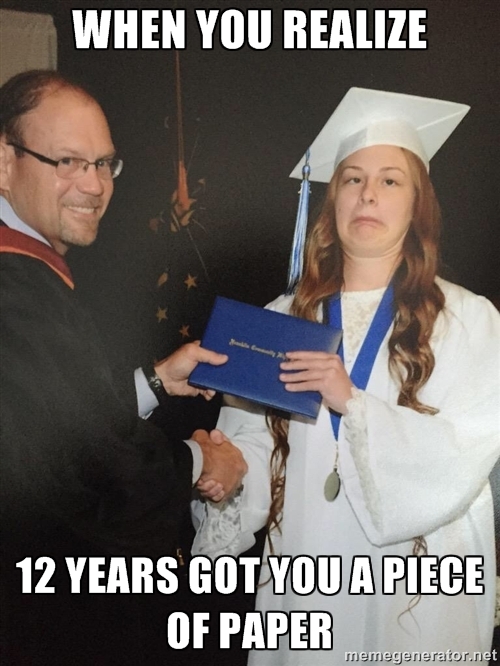
Memes are interesting field. They attempt to convey a message, whether it be jocular or serious, in just a few words. The message often relies on the image that accompanies it and is written on what appears. A favorite meme of mine is the boy in his marching band uniform with himself playing clarinet super-imposed over his brain. It's called PTSD Clarinet Boy because he is often accompanied by messages of his scaring and ache for revenge or aching in general.
For this entry into Blogger I have myself created a meme that can work both as a vehicle for humor and as a critique for the current system of education we operate under. This is the way I think memes can begin to actually mean something, stand for something even. This is a far fetched idea, seeing as the internet is, but hey, let's be hopeful.
Wednesday, December 9, 2015
Charlie Brown
Charles Schulz was some strange philosophical genius. It's weird. Who would have thought that a guy that got rejected by Disney would become one of the best cartoonists to live. Schulz seemed to be Lichtenstein crossed with a four year crossed with a philosopher. His illustrations were great and matched the world the Peanuts gang lived in.
In the 50s, Charlie Brown and co. were neatly drawn and did question too much. As the years progressed, Charlie became more raggedly drawn and had existential crisis after existential crisis. Charlie also faced politics in his later years, something early Charlie would never have done.
Schulz did something few have ever achieved. He created something profound that children can enjoy that became popular. The list of those who did the same is short but prestiged: JRR Tolkien, CS Lewis, and Bill Watterson to name a few. Schulz just create a sort of mirror to modern life and an environment where children can understand it. His contribution to the culture won't soon be forgotten.
Tuesday, December 8, 2015
My Star Wars
I'm worn out. I'm worn out from Star Wars. I'm not excited. I don't really care. I will see it. Not because I'm interested in what it's continuing. Not because I want to. Because there's a social obligation.
When I was younger, my older brother and I would watch Star Wars quite a bit. Not by choice of course, or rather, not by my choice. Here's how the conversation would go:
Me: Let's watch a movie, Patrick(my brother).
Patrick: What movie?
(At the same time)
Me: Not Star Wars. / Patrick: Star Wars.
Patrick: I'm older. We're watching Star Wars.
While Patrick never grew tired of those VHS tapes, I did. Quickly.
Yes. They're well made. I get it. They redefined the genre. These are the answers I give so as not to contract rabies from the foaming-at-the-mouth fanboys I associate with, one of them being my brother.
The genre was redefined in 1968.
In case you didn't know it, sci-fi is not the most respected genre. Not often do you see dramatic sci-fi films, Star Wars and the subsequent sequels and prequels being just that.
What actually redefined the genre was 2001: A Space Odyssey. However much the film has been hyped to you, it's actually worth it even if you leave your couch, or theater, or whatever place you watch it at confused. 2001 is what made sci-fi a respectable film genre.
Before that film B movie sci-fi is what ruled. There was so much schlock played as though it were drama before 2001.
Star Wars was really nothing that new. Even the story for A New Hope comes from a Japanese film called The Hidden Fortress. It's nothing new.
Please, for the rest of us, calm down.
When I was younger, my older brother and I would watch Star Wars quite a bit. Not by choice of course, or rather, not by my choice. Here's how the conversation would go:
Me: Let's watch a movie, Patrick(my brother).
Patrick: What movie?
(At the same time)
Me: Not Star Wars. / Patrick: Star Wars.
Patrick: I'm older. We're watching Star Wars.
While Patrick never grew tired of those VHS tapes, I did. Quickly.
Yes. They're well made. I get it. They redefined the genre. These are the answers I give so as not to contract rabies from the foaming-at-the-mouth fanboys I associate with, one of them being my brother.
The genre was redefined in 1968.
In case you didn't know it, sci-fi is not the most respected genre. Not often do you see dramatic sci-fi films, Star Wars and the subsequent sequels and prequels being just that.
What actually redefined the genre was 2001: A Space Odyssey. However much the film has been hyped to you, it's actually worth it even if you leave your couch, or theater, or whatever place you watch it at confused. 2001 is what made sci-fi a respectable film genre.
Before that film B movie sci-fi is what ruled. There was so much schlock played as though it were drama before 2001.
Star Wars was really nothing that new. Even the story for A New Hope comes from a Japanese film called The Hidden Fortress. It's nothing new.
Please, for the rest of us, calm down.
How to Fly
In the music video for Glisoli at the very end, the children dive headlong into the sky and instead of falling they all fly into the sky.
Something struck me. The way they flew. It wasn't as though they were Superman with arms outstretched in front of them and their legs stretching far behind, but instead they seem to swim through the air.
The arms of the children stretched out and grasped the air and moved it in fistfuls much in the way a child would swim the breaststroke in a pool. The reason this struck me is because when I have dreamt of flying, which happens rarely, it has always been as though I were swimming through the air. It's something I'd never seen put into a picture.
Some may argue that art is meant only as a mirror to our world, but where would those who create fantastical realms be? It is fine to find meaning in comparison to our world but to create to only hold a mirror can occasionally be callous and hardened and saddening. Dreams were meant to be dreamt and a few of them were meant to be shared.
This post serves no purpose but to appreciate the power of the moving image. Without that power of which I believe we are all aware of, we wouldn't be in this class would we? (except for maybe an errant arts credit)
Something struck me. The way they flew. It wasn't as though they were Superman with arms outstretched in front of them and their legs stretching far behind, but instead they seem to swim through the air.
The arms of the children stretched out and grasped the air and moved it in fistfuls much in the way a child would swim the breaststroke in a pool. The reason this struck me is because when I have dreamt of flying, which happens rarely, it has always been as though I were swimming through the air. It's something I'd never seen put into a picture.
Some may argue that art is meant only as a mirror to our world, but where would those who create fantastical realms be? It is fine to find meaning in comparison to our world but to create to only hold a mirror can occasionally be callous and hardened and saddening. Dreams were meant to be dreamt and a few of them were meant to be shared.
This post serves no purpose but to appreciate the power of the moving image. Without that power of which I believe we are all aware of, we wouldn't be in this class would we? (except for maybe an errant arts credit)
Tuesday, December 1, 2015
Jonze and Gondry
Spike Jonze was just in Indiana, last night even. Weird that we would talk about him today. He's a remarkable artist. The man directed Her, Being John Malkovich, Where the Wild Things Are. He's definitely a force to be reckoned.
Michel Gondry wasn't just in Indiana sadly, but he's as much of a force. He directed Eternal Sunshine of the Spotless Mind, Be Kind Rewind, and Mood Indigo. The French director draws on French New Wave and the avant garde movement quite a bit.
Their link is screenwriter Charlie Kaufman. Kaufman is arguably the most postmodern screenwriter of late. His films explore the self in a way few films have. Personal memories, how we lie to ourselves, the duplicity of oneself, and hiding in one's own work to the point where we disappear. He's not the most mainstream screenwriter.
He's known for creating surprisingly original worlds for his characters to live in. His first film, Being John Malkovich, explores the way society makes a puppet of the celebrity and vice versa. In my opinion, his most interesting film is Adaptation. Adaptation, directed by Jonze, started as a simple adaptation of the book The Orchid Thief by Susan Orlean but turned into a journey into his own character (the lead, Nicolas Cage, plays Kaufman and a fictional twin), and a study on the business of screenwriting.
The reason for the connection of these directors is because of their deft handling of the postmodern themes, another reason that their work on modern music videos is so relevant. If music simply slips to a point where we take no meaning for the words or the reason it was written, why write the music?
Michel Gondry wasn't just in Indiana sadly, but he's as much of a force. He directed Eternal Sunshine of the Spotless Mind, Be Kind Rewind, and Mood Indigo. The French director draws on French New Wave and the avant garde movement quite a bit.
Their link is screenwriter Charlie Kaufman. Kaufman is arguably the most postmodern screenwriter of late. His films explore the self in a way few films have. Personal memories, how we lie to ourselves, the duplicity of oneself, and hiding in one's own work to the point where we disappear. He's not the most mainstream screenwriter.
He's known for creating surprisingly original worlds for his characters to live in. His first film, Being John Malkovich, explores the way society makes a puppet of the celebrity and vice versa. In my opinion, his most interesting film is Adaptation. Adaptation, directed by Jonze, started as a simple adaptation of the book The Orchid Thief by Susan Orlean but turned into a journey into his own character (the lead, Nicolas Cage, plays Kaufman and a fictional twin), and a study on the business of screenwriting.
The reason for the connection of these directors is because of their deft handling of the postmodern themes, another reason that their work on modern music videos is so relevant. If music simply slips to a point where we take no meaning for the words or the reason it was written, why write the music?
F for Fake and the Essay Film Genre
Few filmmakers are as revered as Orson Welles. He made what is thought by some to be the best film ever made when he was 26. From then on, he was on a downfall of a sort. Not in his own eyes, but in the eyes of others he fell from grace. This view is a sort of detached view. In his first film, though later lauded by many, he failed. He was personally attacked in a way. William Randolph Hearst, legendary newspaper publisher, was the basis for Citizen Kane, Welles' masterpiece, threatened each theater that ran the film and nearly had the negatives burned before the film was even released.
With being Hollywood's, Broadway's, and radio's golden boy behind him, Welles travelled the world trying to find financing for his many adaptations of Shakespeare.
What I'd like to focus on, however, are his last two films. Welles created, seemingly, a new genre with these two films. The films, F for Fake and Filming Othello, are occasionally categorized as documentaries, but that would mean that Welles was documenting something. In a way in F for Fake, he is, for part of the film. It is a document on an art forger, and then a biographical forger by way of the art forger, but that's just part one.
To take F for Fake as a whole, one would have to take the last 25 minutes or so, which are (spoiler) fictitious! This therefore disqualifies the film as a documentary. What the film is, is an essay film. Less a film journalist turning his camera on a story and more an author telling the audience his thoughts on the subject of forgery, fakery and all around illusion. Welles even begins the film as one might begin a regular essay, establishing his mastery of the subject by demonstrating his own magic tricks.
Filming Othello on the other hand is entirely an essay film, without argument for categorization as documentary. Othello is less a document and more an artist explaining himself. Even on his last film potentially the greatest film artist to live felt he needed to explain himself. That's the kind of essay I want to see.
With being Hollywood's, Broadway's, and radio's golden boy behind him, Welles travelled the world trying to find financing for his many adaptations of Shakespeare.
What I'd like to focus on, however, are his last two films. Welles created, seemingly, a new genre with these two films. The films, F for Fake and Filming Othello, are occasionally categorized as documentaries, but that would mean that Welles was documenting something. In a way in F for Fake, he is, for part of the film. It is a document on an art forger, and then a biographical forger by way of the art forger, but that's just part one.
To take F for Fake as a whole, one would have to take the last 25 minutes or so, which are (spoiler) fictitious! This therefore disqualifies the film as a documentary. What the film is, is an essay film. Less a film journalist turning his camera on a story and more an author telling the audience his thoughts on the subject of forgery, fakery and all around illusion. Welles even begins the film as one might begin a regular essay, establishing his mastery of the subject by demonstrating his own magic tricks.
Filming Othello on the other hand is entirely an essay film, without argument for categorization as documentary. Othello is less a document and more an artist explaining himself. Even on his last film potentially the greatest film artist to live felt he needed to explain himself. That's the kind of essay I want to see.
Tuesday, November 24, 2015
Herzog: Subject and Documentarian
Werner Herzog, one of the most interesting characters working in and around Hollywood today, has been both the subject of and the director of acclaimed documentaries. I first became acutely aware of him when he came to IU a few years ago and I went to see a symposium he gave. He's a pretty weird guy.
He has directed big budget movies and tiny, tiny documentaries. And there's a reason he's been the subject of documentaries in the past. He's very, very strange.
The most famous documentary involving him is called Burden of Dreams. The premise behind the doc is a basic making of for a movie Herzog directed called Fitzcarraldo. The story behind Herzog's film is that of a man who wishes to open an opera house in the Amazon jungle. What Herzog did to portray this was go to the Amazon and build an opera house using harder tactics to do so. Where the original man took apart a ship to place it on the other side of the river, Herzog pulled a whole steam ship across the river.
Herzog is what seems to be insane. In his own documentary Grizzly Man, about a man who would live his summers among the wild bears in Alaska and subsequently being killed by one, he films a scene where he is interacting with one of the man's friends who has the tape to the camera that is the sound of the man being mauled. Herzog listens to the tape with the friend in the room as she begins to cry. Herzog tells the friend to never listen to the tape, something she tells him she will never do.
Lastly, one of the weirdest thing Herzog has done, was eat a shoe. Errol Morris, director of The Thin Blue Line, bet Herzog something and as it seemed, Herzog lost. True to his word, Herzog ate his shoe while Morris filmed it. Strange to say the least.
He has directed big budget movies and tiny, tiny documentaries. And there's a reason he's been the subject of documentaries in the past. He's very, very strange.
The most famous documentary involving him is called Burden of Dreams. The premise behind the doc is a basic making of for a movie Herzog directed called Fitzcarraldo. The story behind Herzog's film is that of a man who wishes to open an opera house in the Amazon jungle. What Herzog did to portray this was go to the Amazon and build an opera house using harder tactics to do so. Where the original man took apart a ship to place it on the other side of the river, Herzog pulled a whole steam ship across the river.
Herzog is what seems to be insane. In his own documentary Grizzly Man, about a man who would live his summers among the wild bears in Alaska and subsequently being killed by one, he films a scene where he is interacting with one of the man's friends who has the tape to the camera that is the sound of the man being mauled. Herzog listens to the tape with the friend in the room as she begins to cry. Herzog tells the friend to never listen to the tape, something she tells him she will never do.
Lastly, one of the weirdest thing Herzog has done, was eat a shoe. Errol Morris, director of The Thin Blue Line, bet Herzog something and as it seemed, Herzog lost. True to his word, Herzog ate his shoe while Morris filmed it. Strange to say the least.
Thursday, November 12, 2015
Malick and the Cinema of Absolution
Terrence Malick, the director of the last movie showed today, has never been normal. Even his first film, Badlands, remains to be a bit of a strange film. The film is another one in a chain of films about a young couple who go on a violent rampage, however it is unlike the rest. Malick doesn't focus on the violence, he focuses on the characters and what might drive them to violence, but doesn't reveal any answers either.
His cinematography is constantly stunning. Even in his first film are these expressionistic shots he became revered because of. His influence can be clearly seen in the video link below:
Not Directed by Terrence Malick
Movies represented there are not too often the beaten path either, Man of Steel being the best example of this.
His cinematography is constantly stunning. Even in his first film are these expressionistic shots he became revered because of. His influence can be clearly seen in the video link below:
Not Directed by Terrence Malick
Movies represented there are not too often the beaten path either, Man of Steel being the best example of this.
Malick seems to be searching in many ways for a cinema of absolutes. He began trying to find it in the tabloids, then in literature, history, The Bible paralleled with the near past, etc. Coming next is a work that seems nearly as uncategorizable as the rest of his filmography. Knight of Cups is described as a fantasy romance drama when you google it but let me know if this trailer backs that statement up or those just seem to be ways to put the film into a box:
The reason I call it cinema of absolutes is because Malick seems with each film to dive into himself. Tree of Life was questioned because of the dinosaurs and other elements. Knight of Cups, it's reported, has no script. Antonio Banderas, who acts in it, had this to say about it: "I arrived to the set and basically what he said to me, he says , ‘Antonio, we didn’t send you a script because we don’t have a script and so this monologue that I gave you,’ which literally didn’t make sense whatsoever, ‘I’m gonna shoot it in nine different locations and I’m gonna just improvise with you, and I’m gonna send you something that I call torpedoes.’ And these torpedoes, they were people that came in the middle of the monologue and started improvising with me. He sent me a beautiful woman, he sent me an old lady, he sent me a bunch of three guys that are rappers. I ended up in a pool with three ladies with my tuxedo." I think that Malick hopes to find one image that will speak to all but can't seem to find it and his filmography is about finding the truth. His truth, truth for all, it's not clear but I certainly want to journey with Malick.
Wednesday, November 4, 2015
The Beauty of Simplicity
The short films shown yesterday were described as simple. I would agree, the concepts therein were simple but the effect can be complex. Not only did the films make us laugh, but they also saddened us. We all laughed when the characters died in The Hell's Kitchen but when the robots fell and committed "suicide" respectively, we all felt sad.
This painting is Willie Gillis in College by Norman Rockwell. Rockwell is often criticized for being simple. While I agree the painting itself is simple, the concept and effect are complex. This painting is part of a series about Willie Gillis, a fictional soldier in World War II. Every other painting in the series shows Gillis in uniform but this one marks the end of fighting and the return of the GIs who might take the GI Bill to go to college. This one represents calm, more settle times for the country.
This painting is by Mark Rothko and is titled No. 5. While the bars of color are arguably more simplistic than Rockwell's Gillis, Rothko holds a standard as a more serious artist proving that simplicity can be better than the complex.
Tuesday, October 27, 2015
Avant Garde and the Wolf
If under the tutelage of Mr. Disney, the creator of Peanuts, Charles Schultz was turned down for a job, Mr. Disney must have been stirring in his coffin during this version of Peter and the Wolf. Many comparisons can be made about the Disney version of the tale and Caroline Leaf's rather strange version.
The similarities are in that they both are based on the same folktale and they both begin with the same score. That's about as many similarities that are between the two. Where Disney's short is an enjoyable, yet cut and dried interpretation and variation to make the story more kid-friendly, Leaf's is, well, less so. Leaf excels at the more direct adaptation while showing perhaps a more primal approach. These sand drawings recall the cave drawings many associate with the earliest pictorial storytelling.
Leaf tells great stories in my eyes. My favorite that we saw teeters in between Two Sisters and The Street. I'm not sure what draws me to those two. Possibly that the stories are so inherently human, expecting to be rejected and dealing with the death of a loved one. Few popular mediums tell stories like this anymore.
Most of the films that make it to mainstream theatres aren't honest even if they try to be. The last "documentary" that reached the multiplex in my hometown was 2016: Obama's America, despite all of you political feelings, I think we can all agree that a heavily right-slanted film about things that have yet to come and presume the worst shouldn't call itself a documentary. Perhaps an honest story can't be told to the modern masses anymore.
News shows are losing viewers by the day and newspapers are losing subscribers by the minute. Twitter is where news lives now and it lives in 140 character whether the story deserves that or not. News is now told with a joke and a wink and a smile by the likes of Trevor Noah and John Oliver. True, human stories aren't told straight anymore and maybe that's why I like Caroline Leaf. Maybe we could all learn something from her. Maybe the above is why she hasn't worked in over a decade.
The similarities are in that they both are based on the same folktale and they both begin with the same score. That's about as many similarities that are between the two. Where Disney's short is an enjoyable, yet cut and dried interpretation and variation to make the story more kid-friendly, Leaf's is, well, less so. Leaf excels at the more direct adaptation while showing perhaps a more primal approach. These sand drawings recall the cave drawings many associate with the earliest pictorial storytelling.
Leaf tells great stories in my eyes. My favorite that we saw teeters in between Two Sisters and The Street. I'm not sure what draws me to those two. Possibly that the stories are so inherently human, expecting to be rejected and dealing with the death of a loved one. Few popular mediums tell stories like this anymore.
Most of the films that make it to mainstream theatres aren't honest even if they try to be. The last "documentary" that reached the multiplex in my hometown was 2016: Obama's America, despite all of you political feelings, I think we can all agree that a heavily right-slanted film about things that have yet to come and presume the worst shouldn't call itself a documentary. Perhaps an honest story can't be told to the modern masses anymore.
News shows are losing viewers by the day and newspapers are losing subscribers by the minute. Twitter is where news lives now and it lives in 140 character whether the story deserves that or not. News is now told with a joke and a wink and a smile by the likes of Trevor Noah and John Oliver. True, human stories aren't told straight anymore and maybe that's why I like Caroline Leaf. Maybe we could all learn something from her. Maybe the above is why she hasn't worked in over a decade.
Tuesday, September 22, 2015
The Bunny
Maybe I've got some psyche issues I have yet to realize or treat or something or the other, but while The Bunny was a cutesy story with a "happy" ending, I couldn't help but feel sad. To me, the bunny getting in the oven was a suicide. I saw in The Bunny what I saw many years ago in a Br'er Rabbit story. No, it's not because they're both rabbits, what I actually drew the parallel with was Br'er Fox. In the story Br'er Fox is preparing for his wife when he remembers something Br'er Rabbit told him the other day (some of this I'm sure is inaccurate but br'er with me), which was that the new fashion was to take off your head with an axe before you go to sleep at night. Br'er Fox and his wife argue a little bit about this before she agree to help him do it and she chops his head off and of course dies, but for some reason she doesn't realize this till the morning when she can't reattach his head or can't wake him or something inane and very frightening and scary to a child sitting in a Qdoba reading this across from his father. Anyway, the moral was don't follows fashions because they're almost always fads. At this point you may be wondering why I connect that with The Bunny.
What I saw in the Bunny was a suicide. The bunny finally gave over to senility she had been fighting for years and climbed into the oven and died. In the morning the mail man will come by and wonder why old bunny Janice isn't out front with the cake she promised him and he'll knock and knock and call the bunny police and they'll go into an oven turned on with a rabbit stew halfway done. This is not fantastical or transformative to me. It's sad and depressing. Someone please explain The Bunny in a way I understand because for the life of me, that's sad.
Saturday, September 5, 2015
Joseph Walls
Hi everyone. I'm Joseph Walls. I'm a freshman film studies, journalism double major. I'm from a town half an hour south of Indianapolis named Franklin. My favorite genre of movies are dark comedies but I like a lot of movies anyhow. I don't have an all time favorite film but I do have favorites of certain genres. The goal of my majoring in film is to become a writer-director. I hope to one day make a film that will be some day make the end of a best comedies list in some back alley website. I love records. I prefer soundtracks and have some great ones, like the soundtracks to 8 1/2, Psycho, or The Good, the Bad, and the Ugly. I've been in some theater productions like The Sound of Music, Peter Pan & Wendy, Singing' in the Rain, and Arsenic and Old Lace. I think being in these productions helped gestate my desire to be a director. I hope to one day be as good as Frank Capra. I've nevermind made a film but I'd love to get started, and for any of you wondering what to watch, go to criterion.com, their list of films is the greatest compiled in my opinion. Oh, and I'm currently reading Hitchcock/Truffaut. It's great. Follow me on the various social medias: @wallsallaround.
Subscribe to:
Comments (Atom)